
African baobab tree
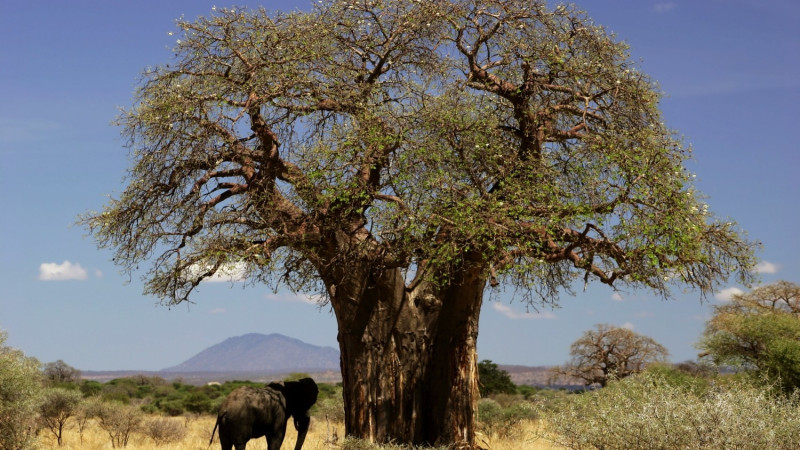
A tree like from another world
With its massive trunk and gnarled branches, the African baobab tree (Adansonia digitata) is one of Africa's most extraordinary trees. Its distinctive appearance is particularly striking during the dry season: without leaves, its crown looks almost as if the roots of an upturned tree are reaching towards the sky. It's no wonder, then, that stories and legends have surrounded the baobab for generations.
But there's much more to its unusual appearance. Baobabs can grow exceptionally old, store water in their mighty trunks, and open striking blossoms when other plants have long since disappeared into darkness. Reason enough to get to know this special tree a little better.
Why does the baobab tree look like it's standing upside down?
During the dry season, the baobab tree sheds its leaves. Then, its strong, far-reaching branches truly resemble a root system reaching towards the sky. This unusual appearance has given rise to numerous stories surrounding the tree.
According to legend, the baobab tree was planted upside down, so its roots have pointed towards the sky ever since. Botanically, of course, it's not an upside-down plant, but the story illustrates how extraordinary the tree has always seemed to people.
How old does a baobab tree really get?
Almost as many stories surround the age of the baobab tree as its unusual shape. Estimates of several thousand years are frequently cited. However, determining the age of these mighty trees is actually difficult, which is why researchers resort to methods such as radiocarbon dating.
Scientific studies nevertheless reveal impressive figures: For example, the famous Glencoe baobab in South Africa was determined to be around 1,800 years . Studies of other ancient specimens also show that baobabs can reach an exceptionally old age.
Who visits the baobab tree at night?
As darkness falls, the African baobab tree puts on a spectacular show. Its large, white blossoms open at night and can reach a diameter of about 20 centimeters . They hang from the branches on long stems, making them easily accessible to nocturnal visitors.
Among the pollinators are bats and galagos, small nocturnal primates of Africa. While many people immediately think of bees when it comes to pollination, the baobab also relies on unusual helpers of the night.
A tree trunk as a giant water reservoir
The mighty trunk of the baobab tree is not only responsible for its unusual appearance. Its spongy wood can absorb large quantities of water during the rainy season. These reserves help the tree survive the pronounced dry periods of its natural habitat.
Animals also know how to use this ability. Elephants can break open the bark and soft wood of baobab treesto get to the water-rich plant matter inside the trunk.
A tree as a signpost
Baobabs were not merely striking features of the landscape. Their impressive size and enormous lifespan made individual trees important landmarks. Historical accounts describe how trade routes were sometimes guided by prominent baobabs, and some trees even had their own names.
Thus, a baobab was far more than just a tree by the roadside. For generations, the same tree could serve as a highly visible landmark for travelers, becoming an integral part of the landscape and its history.
When a tree becomes a space
The mighty trunk of an old baobab tree can contain large cavities. Over time, people have used such hollow trunks in surprisingly diverse ways. Documented uses include shelter, storage space, and water containers. There are also reports of particularly unusual uses of individual baobab trees as living quarters.
In many places, the baobab was therefore not just part of the landscape. Its extraordinary size meant that individual trees were practically integrated into people's lives.