
ginkgo
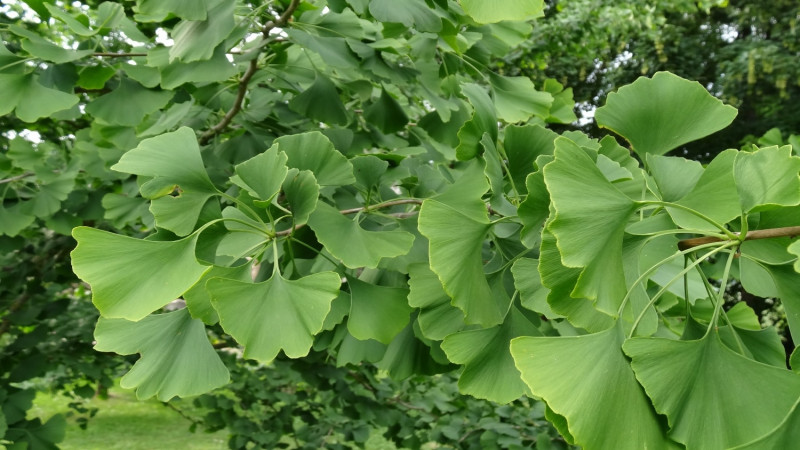
A survivor from a long-vanished plant world
The ginkgo (Ginkgo biloba) occupies an exceptional position in the plant kingdom. Fossils of related ginkgo species reach far back into Earth's history, but today Ginkgo biloba the only living representative of its genus, family, and order. Kew therefore refers to it as a "living fossil."
Its distinctive fan-shaped leaves make the tree easily recognizable. In autumn, they turn a vibrant yellow before falling. The species name *biloba* refers to the often bilobed shape of the leaf blade.
Did the ginkgo tree really survive the dinosaurs?
The ginkgo tree living today, of course, didn't stand next to a dinosaur in person. However, its lineage is ancient. Fossils of ginkgo-like plants are known from the Mesozoic Era, a time when dinosaurs roamed the earth.
Of this once more diverse group of plants, only Ginkgo biloba remains today . This makes the tree not simply an old plant species, but the last living representative of an entire branch of plant evolution.
Why are there male and female ginkgo trees?
Ginkgo trees are dioecious. This means that male and female reproductive organs are found on separate trees. The trees only reach reproductive maturity after many years. Kew cites a period of approximately 20 to 35 years.
Female ginkgo trees produce seeds with a fleshy outer layer after successful fertilization. When this layer falls to the ground and decomposes, it can develop a decidedly unpleasant odor. For this reason, male ginkgo trees are often preferred for streets and public spaces.
What connects Goethe with the ginkgo?
The ginkgo also became part of German literary history. Johann Wolfgang von Goethe was fascinated by the unusual shape of its leaves and incorporated it into his poem "Ginkgo biloba" in 1815.
He was particularly fascinated by the question of whether the leaf consists of two interconnected parts or is a whole divided into two parts. For him, the ginkgo leaf thus became a symbol of unity and duality.
In September 1815, Goethe sent Marianne von Willemer a ginkgo leaf. He referenced the leaf's distinctive shape in his poem "Ginkgo biloba." Later, he even attached two crossed ginkgo leaves to the handwritten poem.
A tree with a cultural history spanning millennia
The ginkgo has been cultivated in East Asia for a long time and is traditionally planted in temple gardens. This human cultivation is particularly important for its history, because with some old stands in China it is not yet possible to determine definitively whether they are truly wild or descended from trees that were cultivated in the past.
Today, the ginkgo tree has spread far beyond its original habitat. It has been planted worldwide as an ornamental and urban tree, thus becoming, ironically, the last representative of an ancient group of plants to achieve international renown.
How old can a ginkgo tree get?
Not only does its evolutionary history stretch far back in time, but individual ginkgo trees can also reach an impressive age. Kew reports documented specimens up to approximately 3,500 years old.
Remarkably old specimens can also be found in Europe. One of the historic ginkgo trees in the Royal Botanic Gardens, Kew, is one of the garden's so-called "Old Lions." It was in 1762 and is still growing there today.