
Mountain redwood
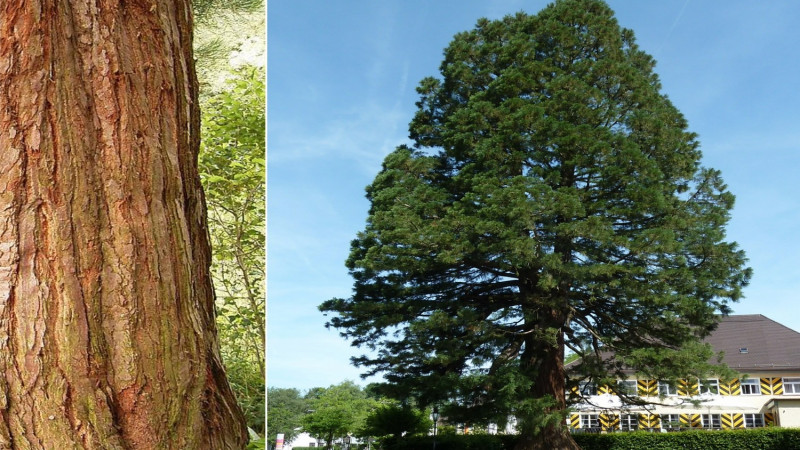
A giant from the Sierra Nevada
The giant sequoia (Sequoiadendron giganteum) is one of the most impressive trees on Earth. In its natural habitat, the Sierra Nevada in California, mature specimens can reach heights of over 90 meters and enormous trunk diameters.
But it is not only its size that makes the giant sequoia so extraordinary. Some specimens survive for millennia, fire plays a surprisingly important role in its life cycle, and even underground it hides a special feature that one would hardly expect from such a giant.
Is the giant sequoia the largest tree in the world?
It depends on how you define size. Other tree species can grow taller or reach particularly massive trunk diameters. However, measured by wood volume, giant sequoias are among the largest living trees on Earth.
The most famous example is the General Sherman Tree in Sequoia National Park. Its trunk contains more wood than that of any other known living tree. Its age is estimated at approximately 2,200 years .
The General Sherman Tree is neither the tallest nor the oldest tree on Earth. Its fame stems primarily from its enormous trunk volume, which makes it the largest known living single tree by volume.
Why is fire important for a giant sequoia tree?
Fire might initially sound like the greatest enemy of a forest. However, for the giant sequoia, it has been a natural process in its habitat for millennia. Regular ground fires can eliminate competing vegetation, expose the forest floor, and create gaps in the canopy.
This allows more light to reach the ground, providing better growing conditions for young sequoia trees. When natural fires were consistently suppressed for extended periods, the successful regeneration of sequoia populations also declined.
Hundreds of seeds in a small cone
Considering the enormous size of a mature sequoia, its cones appear surprisingly small. They only grow to about five to nine centimeters in length. Nevertheless, a single cone can contain an average of around 200 seeds .
It is also remarkable that even very old and large mountain sequoias can still produce cones with viable seeds. A tree can therefore have outlived many human generations and still reproduce.
A giant with surprisingly shallow roots
With a tree of this size, one might expect its roots to reach deep into the ground. In fact, giant sequoias have a comparatively shallow root system. Instead of penetrating deep into the soil, their roots spread out over a large area around the tree.
In a sequoia grove, the roots of different trees meet and can become intertwined. Beneath the mighty trunks lies an extensive network of roots, barely perceptible from the surface.
Why was the giant sequoia once called "Wellingtonia"?
When the mountain redwood became known in Great Britain in the 19th century, it was given the scientific name Wellingtonia gigantea in honor of the Duke of Wellington, who had recently died .
Botanically, however, there was a problem: the name Wellingtonia had already been used for a different genus of plants. Therefore, the name did not gain lasting scientific acceptance. Nevertheless, it has not disappeared entirely. In Great Britain, "Wellingtonia" is still sometimes used today to refer to the giant sequoia.