
New Zealand Christmas tree
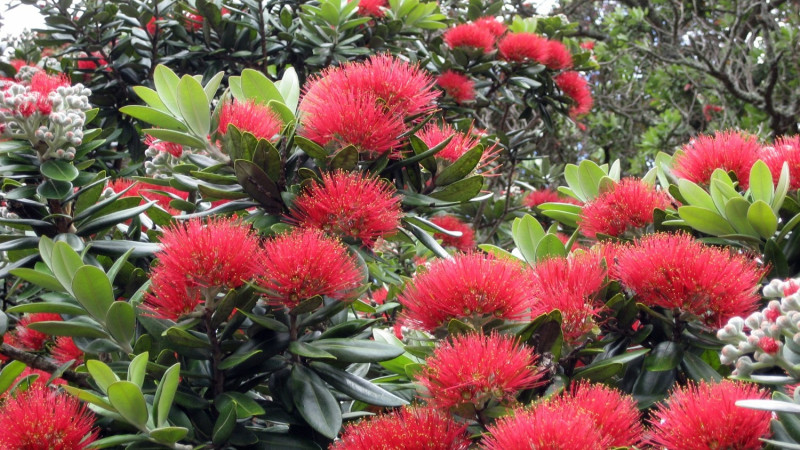
Christmas under bright red blossoms
The New Zealand Christmas tree (Metrosideros excelsa), known in New Zealand primarily as Pōhutukawa , is one of the characteristic trees of the New Zealand coastal landscape. Its dense flower clusters with numerous long, mostly dark red stamens are particularly striking.
The tree owes its German name to its flowering season in the Southern Hemisphere. Around the New Zealand summer, the red blossoms transform some coastal areas into a striking sea of color. This has led to the Pōhutukawa being closely associated with Christmas in New Zealand.
Why does the Pōhutukawa grow specifically on the coast?
The natural habitat of the Pōhutukawa tree is primarily in the coastal regions of New Zealand's North Island. There, it often grows under conditions that would be extremely challenging for many other trees.
Wind, salty air, and rocky terrain characterize many of its natural habitats. Old specimens can develop mighty, spreading crowns and sturdy trunks, thus becoming a striking feature of the coastal landscape.
A tree with unusual roots
The pōhutukawa tree can not only form roots in the ground. So-called aerial roots grow down from its branches. If they reach suitable soil, they can continue to grow there and provide additional support for the spreading tree.
This ability is one of the special characteristics of the genus Metrosideros and contributes to the distinctive appearance of old specimens. Trees whose branches and roots spread over rocks and embankments are particularly impressive.
Why is the Pōhutukawa of special importance to Māori?
The pōhutukawa holds special significance in Māori culture and tradition. A well-known tale connects its red blossoms with the young warrior Tāwhaki. According to the legend, the red flowers are meant to symbolize the blood he lost after falling to earth while attempting to avenge his father's death.
Also particularly well-known is an old pōhutukawa at Cape Reinga on the northern tip of New Zealand. The New Zealand Department of Conservation describes it as part of a Māori tradition about the journey of the deceased.
Māori tradition: At Cape Reinga, an old, wind-scarred pōhutukawa tree grows on the cliffs. According to tradition, this place is connected to the journey of the spirits of the deceased back to their original homeland. The tree is therefore not only a botanical curiosity but also part of a culturally significant landscape.
When a Christmas tree becomes a summer tree
For people in the Northern Hemisphere, Christmas, winter, and evergreen conifers are closely linked. In New Zealand, however, Christmas falls in the middle of summer. It is precisely at this time of year that the red blossoms of the pōhutukawa tree dominate the landscape in many places.
This gave rise to a unique Christmas symbolism. Instead of a tree, which is primarily associated with Christmas because of its evergreen needles, the focus of the Pōhutukawa is its striking summer blossom.
A tree under animal pressure
However resilient the pōhutukawa may be to coastal conditions, it is not automatically protected against introduced animal species. The common brushtail possum, in particular, introduced from Australia, can severely damage the trees.
The New Zealand Department of Conservation reports that pōhutukawa trees are among the plants favored by possums. With heavy and persistent browsing, even mature trees can die within a few years.