
True mimosa
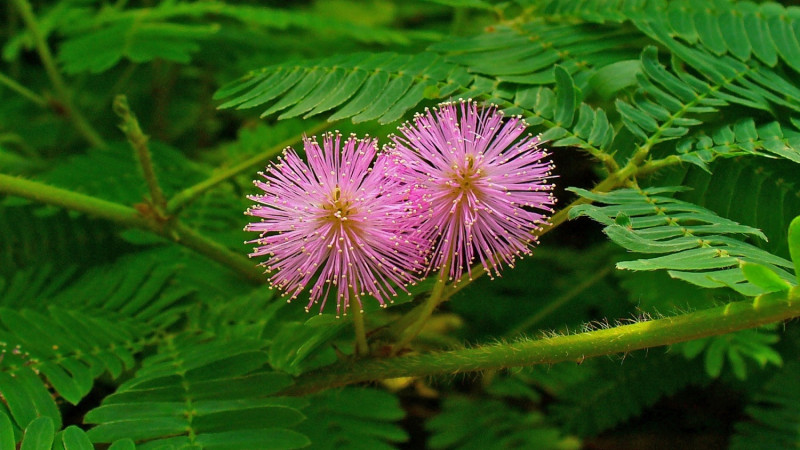
A plant that reacts to touch
The true mimosa (Mimosa pudica) possesses an unexpected ability in a plant: when one of its delicate leaves is touched, the small leaflets can fold up within a short time. With a stronger stimulus, the entire leaf stalk can even droop.
This striking behavior has made the mimosa one of the best-known plants for the study of plant movement. Centuries ago, scientists were already investigating how a plant without muscles or nerves could react so clearly to its environment.
How can a plant move so fast?
No muscles are behind the movement. The key lies in special movable areas at the base of the leaves, the so-called pulvini. When the plant is mechanically stimulated, signals spread and the water distribution in certain cells changes. This alters the internal pressure within the cells, causing the leaf to move.
Later, the leaves straighten up again. The visible movement is therefore not caused by the plant suddenly growing, but by reversible changes in water pressure in its cells.
As early as the 17th century, the English naturalist Robert Hooke studied the striking movements of the mimosa plant. At that time, there was even discussion about whether plants might possess structures similar to the nerves and tissues of animals.
Why does the mimosa tree fold its leaves together?
One possible function of this rapid reaction is protection against herbivores. If a leaf is touched or shaken, the mimosa can significantly change its shape within a short time.
Small animals could be disturbed by the sudden movement or knocked off the leaf. Scientifically, this rapid reaction is therefore interpreted, among other things, as a possible defense strategy against herbivores.
Why does the mimosa "sleep" at night?
The leaves of the mimosa plant do not only react to touch. They also exhibit so-called sleep movements: their position changes throughout the day, with the leaves closing before the dark phase and opening again later.
Such movements are nyctinasty . The mimosa thus reacts not only to a hand, a draft of air, or a vibration, but also exhibits regular leaf movements in connection with the day-night rhythm.
A small plant with a worldwide distribution
, the natural distribution of Mimosa pudica extends from Mexico to tropical America. However, the species is now found far outside its original habitat.
The mimosa has been introduced to numerous tropical regions of Africa, Asia, and Oceania. However, it is by no means a mere botanical curiosity everywhere: Kew points out that in some regions it can occur as a problematic invasive plant.
Where does the name "pudica" come from?
The species name *pudica* can be roughly translated as "shy" or "shy." This is strikingly fitting for a plant whose leaves seem to retract when touched.
Several common names in other languages also reflect this characteristic. In English, for example, one finds terms such as "sensitive plant," "touch-me-not plant," or "shameful plant." This unusual movement has therefore not only occupied scientists but also influenced the plant's naming.